
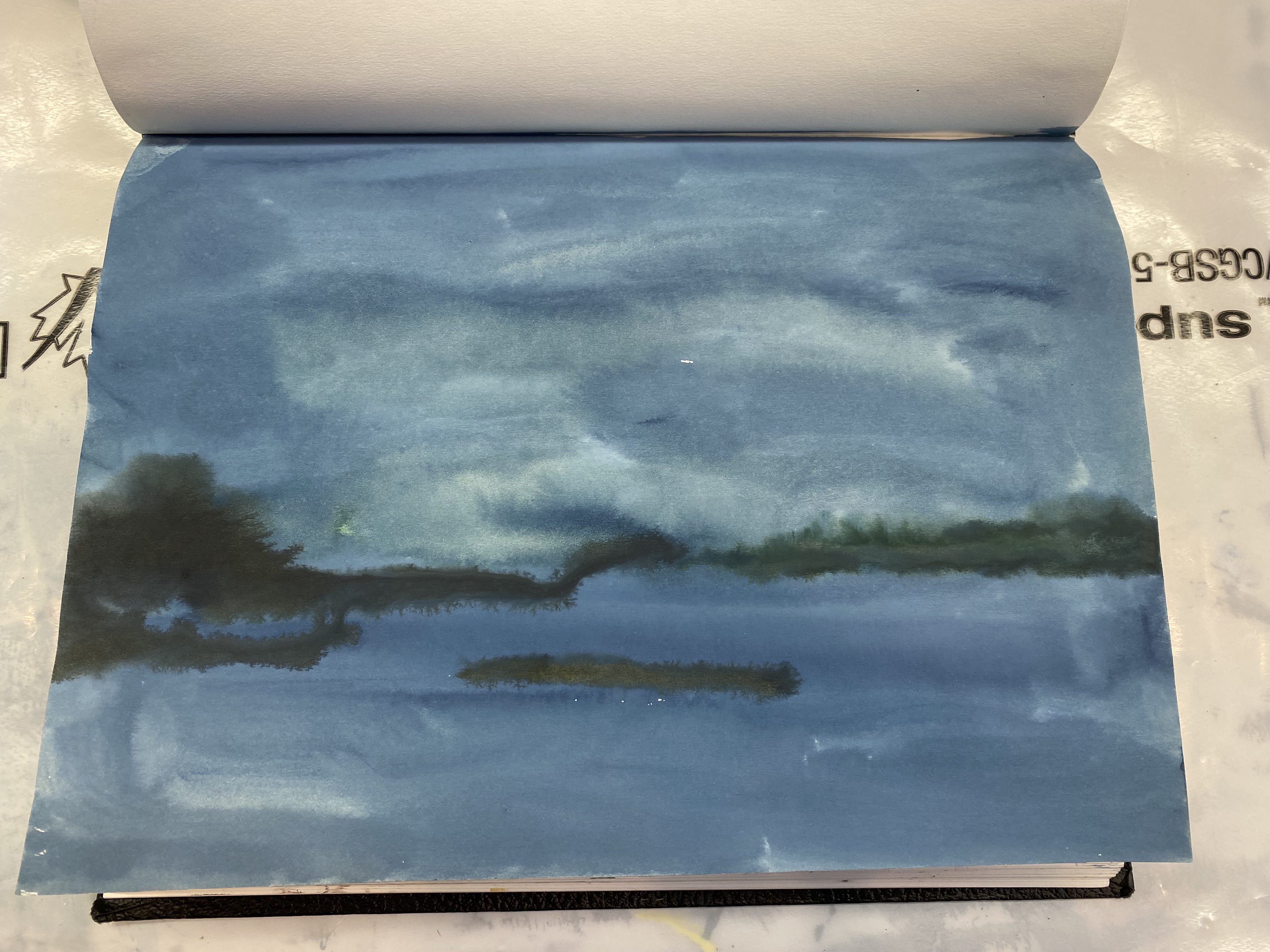
I noticed this in an old sketchbook. Now I am going to see if I can find some watercolours that I painted that day.


Notes from My Studio - Pat Service

You know those treasures we can still find in second-hand stores, the paintings painted on real velvet? They gave me the idea of starting with a black canvas, which is the opposite of how I have traditionally worked. Using different blues, reds, and yellows, I mixed my own blacks, then layered thin washes on the canvas until the surface reached a rich matt finish. This formed the base for the brush marks I placed on top, the marks thick and thin, opaque and transparent, with their edges jagged or smooth depending on how the brush draws across the canvas. The dark grounds make the colours pop, but also the dark grounds make a wonderful surface to draw on. Below you can see the steps I took to paint a Black Velvet painting.
1.
2.
3.
4. 
5.
6. 


For the past month or so, I have been quite entertained by this biography. Written in 1992, it is full of endless details and sometimes cutting comments about the subjects' behaviour.
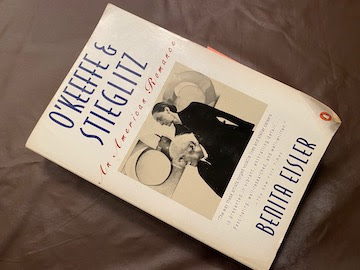
Because Steiglitz had his renowned gallery 291 and later The Place, Alfred and Georgia knew and interacted with many artists, collectors, critics and society figures. The names are so familiar: Charles Demuth, Ansel Adams, Paul Strand, Florine Stettheimer, Mabel Dodge Luhan, it goes on and on; they seemed to know everybody, wealthy and not.
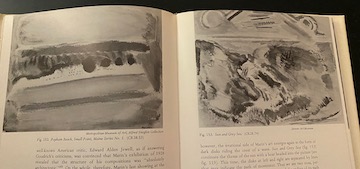
One artist that I was inspired by, John Marin, was a good friend of theirs. I always wanted to see more of the actual paintings and drawings that he created; they were full of energy and life. But it was curious to hear about him as a human being with the flaws and ups and downs in his relationship with them.
O'Keefe and Stieglitz were brilliant artists, and brilliant marketers, but they were not brilliant in interacting with each other or with their friends. Living at a time when people wrote letters, there is quite a record of their thoughts and behaviours, not only through their own letters but also through the letters of others. The author doesn't hesitate to note how nasty and even cruel they could be, the both of them, on occasion when interacting with each other and their friends and acquaintances.
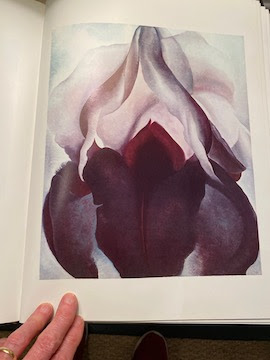
While reading, I dug out an old coffee table book that had reproductions of Georgia's work. I hadn't really looked at any of her paintings for a long time. What surprised me was that I liked them more than I remembered; but however I was unsettled that my recent floral inspirations may have been influenced by what I saw so many years ago.
Georgia O'Keeffe, 'Black Iris', 36x30", 1926
They worked hard, all their life, and saw the rewards for that, Georgia more than Alfred at the end. When he died, he was quite hard up. Georgia being younger had more time to produce paintings and lived long enough to become a very rich woman.

Lately people have been asking if I am still painting. The world has been in turmoil for a while now, however most of us artists just carry on as usual. We go to our studios and pick up a paintbrush or whatever is our favourite tool.
After I sent my paintings to Newzones Gallery in Calgary for my landscape show in March (yes, that March and no I wasn’t able to attend the opening), I returned to a series that I had started in 2019. The subject is something new for me, or new/old. Years ago I painted flowers, flowers by themselves or flowers in still lifes. I had some success with those paintings and was very happy with them. Eventually though I decided that I couldn’t compete with nature, nature had more sophisticated tools than I had, and I turned aside from that challenge.
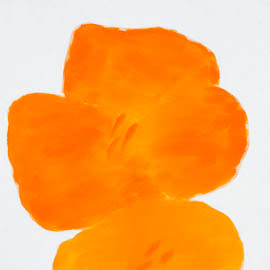
It seems that this past decade of exploring colour – and simplifying detail to do so – has somehow led me full circle, however. Looking for a new starting point I started tentatively thinking of flowers again. In the same way that I had simplified the landscape, I saw how the flowers could be a beginning. This wouldn’t be an attempt at verisimilitude; this series isn’t really ‘of’ flowers. The flowers with their radiance and intensity initiate the act of putting paint on canvas but they don’t control the result. The result has more to do with the curious act of ‘painting’, playing with hue, surface texture and markmaking.

Pat Service's Flowers
The subject of flowers is, in every sense, central to the new series of paintings by Pat Service. Departing only slightly from her almost constant concern with depicting broader aspects of the landscape, Service has made an abundant sequence of square canvases, in sizes ranging from 20 x 20 inches to 42 x 42 inches, each holding, at its centre, identifiable portrait of a single blossom. Detached from stem, leaves or even a background shade, each unique flower head appears, greatly magnified, like a target, flattened and alone within a square frame, the arrangement reading like a hypnotic spiral analogous to the actual formation of a blossom in nature.
These bold flower paintings seize and touch the viewer in an instant, in a way that only a painted picture can do and, of course, further unhurried inspection reveals a richness at the heart of the thing. Each represents a different botanical specimen presumably based on a real life sample but it is clear that realist portrayal is not at issue here. Pat Service is merely an admirer of natural bouquets not an expert horticulturalist. All the same, like all of Service’s work, The Flower Paintings find origin in the surroundings of her life and observations but interpretively expand upon the dull limits of outward appearances. Only the small circles, signifying pistils, anchoring each floral shape at its centre have a peculiar exactness intimating a notion of plant science but ultimately make no concession to accuracy or illusionism. From painting to painting, each monochrome palette varies hues that are only casually attendant to the natural spectrum. Mainly the paint is applied on its own terms abjuring the contours and folds faithful to delicate petals in favour of examining the plain and uncomplicated contour of a flat canvas. Thinly, I think, at first and never awfully thick, a loose but solid wash forms the general silhouette of each bloom over which short, sturdy, brusque strokes of the same colour introduce textures and nuanced, layered tones pushing the colour to the edges of the petals, ragged in places with the unfussy dragging of a dry brush. Around the outside contours of each posy is a thin strip of raw, un-primed canvas like an outline separating the spectacular, large flower from the surrounding negative space remaining in the frame. The negative space is painted white, titanium white, making the lack of spatial definition a deliberate and integral element of the composition, the thin border of ivory white, unpainted canvas left around the flower describes the line of an invisible drawing.
The tradition of floral painting and its connotations for the cycles of life, domestic comfort and ephemeral glory reaches back to the ancient world. It also drags disparaging associations of a dainty banality, a cloying impression of amateur crowd pleasing so-called feminine art. At a glance, Pat Service’s flowers can remind a viewer of the particularly delicate, somewhat Victorian custom of pressed flowers but in another glance, this bold art bears a stronger and favourable comparison to Andy Warhol’s 1964 Flower Paintings. To my mind, the similarities are most obvious in the square formats used by the two artists and in the matter-of-fact flat applications of vivid colours often incongruous to the shared floral subject. Of course, Warhol’s flowers are silkscreened from a found magazine image and Service has painted hers by hand but there is a clearly generic character to either series. Neither Andy Warhol’s or Pat Service’s versions of this subject are really about flowers. This work concerns the vital act of portrayal, of working paint and colour and form to render a familiar theme in an unfamiliar way and convey the essence and ordinariness of beauty.
NW
October 2020


